Raymond LM Ho
HIV testing provides a means to diagnose HIV infection for an individual or the population. A population diagnosis refers to an assessment in epidemiologic surveillance for informing public health action. At individual level, HIV testing forms the gateway to care, treatment and support for persons in need. Over twenty years ago at the beginning of the AIDS epidemic, HIV testing in fact served the primary role of protecting blood safety, an objective that has brought together population screening and individual action. Scientific advances have improved the prognosis of the infection, and with it, the approach to HIV testing. To make public health impacts, HIV testing is strategically organised in programmes with specific objectives depending on a combination of factors including HIV prevalence, resources available, the settings, access to antiretroviral treatment, and behavioural HIV risk in the community.1
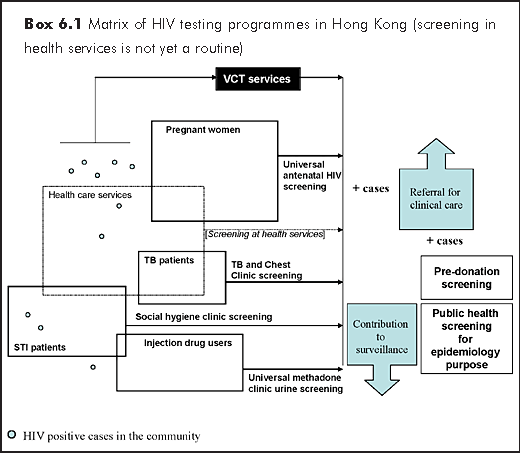
This chapter is devoted to a description of HIV testing programmes in accordance with internationally adopted principles, while carrying a local perspective. Programmes for individuals here include (a) voluntary counselling and testing (VCT) for people who seek testing in non-clinical setting, and (b) screening in health care settings. Diagnostic testing for clinical indication in individuals falls outside the scope of the discussion. On the other hand, surveillance programmes constitute another form of HIV testing activities which do not lead to action at individual level but rather support the generation of public health strategy (Box 6.1).
The World Health Organization (WHO) has estimated that up to 180 million people are in need of HIV testing and counselling every year.2 Worldwide, designated VCT service are established that tailor to the needs of whoever wanting to be tested, or when one has been exposed to potential risk of infection. An integral component of VCT is HIV counselling, normally a confidential process that enables individuals to examine their knowledge and behaviours in relation to their personal risk of acquiring or transmitting HIV infection. Counselling helps to make a decision on whether or not one is to be tested and provides support when receiving the test result. Promotion of VCT facilitates early diagnosis and management of infected people.
In Hong Kong, the Government's AIDS Counselling and Testing Service (ACTS) consists of the AIDS Hotline (2780 2211) service and VCT clinic. The Hotline provides an easy access to testing, and is integrated with the delivery of information on AIDS and sexually transmitted infection (STI). An appointment is given for individual counselling to be conducted in a face-to-face setting, followed by the HIV antibody testing at a clinic. The service is free, confidential and anonymous. The same AIDS Hotline also provides pre-recorded messages in English, Cantonese and Putonghua. Nurse counsellors are available to perform confidential voluntary HIV antibody testing and counselling.
Other than ACTS, HIV testing is provided by non-governmental organizations (NGO). Hong Kong AIDS Foundation and AIDS Concern are examples of NGO that provide HIV counselling and testing to people in need. One important feature of VCT, Governmental, or NGO's, is the linkage with clinical treatment services. Referral is made in the event that a positive case is diagnosed. For negative results, post-test counselling is offered on the reduction of risk associated with the infection.
US Centers for Disease Control and Prevention (CDC) has estimated that more than half of the new HIV infections are spread by HIV-positive persons who are unaware of their infection. In nearly 40% of persons who received a diagnosis of HIV infection, AIDS either was concurrently diagnosed or developed within a year.3 As a result of delayed diagnosis, these patients fared far worse and may die sooner than those whose infections were diagnosed promptly. Some may unknowingly spread HIV to their spouses, partners, and others. Early diagnosis therefore carries not only benefit for the individual but also the society. Prompt diagnosis offers an opportunity to counsel on the reduction of high-risk sex, and transmission is further reduced by treatment that decreases the viral load in the blood and hence transmissibility of the infection.
There has been debate on whether HIV testing should be offered as a routine part of medical care. The recent World Health Organization initiative to enhance treatment access results in a sharp increase of the number of people tested for HIV, and a further increase in the demand for the testing. The conventional model of VCT which goes by the identification of individual risk behaviours is clearly inadequate. The US CDC, in its new guidelines on HIV testing, called for routine screening in all health services unless a diagnostic yield of less than 0.1% is established.4 Screening here is defined as the performance of the test for all persons in a defined population. According to UNAIDS/WHO policy (2004),5 a routine offer of HIV testing by health-care providers should be made to all patients being:
(a) Assessed in an STI clinic or elsewhere for a sexually transmitted infection - to facilitate tailored counselling based on knowledge of HIV status.
(b) Seen in the context of pregnancy - to facilitate an offer of antiretroviral prevention of mother-to-child transmission.
(c) Seen in clinical and community-based health service settings where HIV is prevalent and antiretroviral treatment is available (injecting drug use treatment services, hospital emergencies, internal medicine hospital wards, consultation etc) but who are asymptomatic.
It is important to note that despite the 'routine' and 'opt-out' nature of HIV screening, the principles remain that (a) the process is a voluntary one with informed consent which may be oral or written depending on the setting, or incorporated in the general consent as appropriate; (b) information on HIV is provided; (c) patients may elect to decline or reject the offer; and (d) referral system is in place to ensure that quality care is delivered to those in need.
The presentation of STI patients for treatment offers an opportunity for providing HIV testing. In Hong Kong, Social Hygiene Clinics run by the Department of Health offers STI treatment to patients in needs. The service is free for local residents. Each year about twenty thousand patients attend these clinics located in different districts of the territory. Other services provided at the Social Hygiene Clinics include risk reduction counselling, identification of partners and their treatment, and HIV screening. In these clinics HIV tests are provided on an opt-out basis. Social Hygiene Clinics accounted for 10-15% of reported HIV infection in Hong Kong.
In order to prevent newborns from contracting HIV through their infected mothers, a universal antenatal HIV testing programme was launched in September 2001 in Hong Kong. Every pregnant woman who attends public antenatal service (Maternal and Child Health Centres and Hospital Authority Obstetric Units) is provided with a voluntary HIV antibody test using an opt-out approach. The programme is supported by the provision of information, education and appropriate counselling. Referral to HIV specialist clinics is made for mothers tested positive for the infection, and for babies born to these mothers to Paediatric units. The programme serves also the objectives of promoting healthy pregnancy, enhancing public awareness towards HIV/AIDS, and supporting early diagnosis of the infection in women and spouses. As of the end of 2005, only 0.6% of all reported HIV infections in Hong Kong were perinatally acquired, and all of which occurred before the programme came into effect.
The programme was reviewed from the period September 2001-December 2004 and found to be efficient and effective.6 The screening programme exhibited a broad coverage of over 97% acceptance rate among eligible antenatal women and the identification of HIV positive pregnancies. Whereas obstetric care in private sector falls outside the scope of the programme, guidelines have been established to promote the same practice throughout the territory. Statistics are collected, revealing that some 80% of mothers delivering in maternity services in private hospitals have had their HIV status determined. The role of antenatal screening is further discussed in Chapter 35.
Methadone Treatment Programme (MTP) was started in 1972 as a pilot scheme and subsequently launched formally in 1976. Currently, there are 20 methadone clinics in the territory. Substitution treatment is the hallmark of the programme, and this has been proven to be one effective measure in the prevention of HIV transmission in injection drug users. The low threshold approach, open-door policy (to heroin users irrespective of sex, age, ethnic origin, religion or nationality) and voluntary treatment are characteristics of the programme. No referral is required for the service which charges eligible attendee a nominal HK$1 per visit. A multi-disciplinary team is in place involving the efforts of doctors, social workers and the Auxiliary Medical Services. The MTP in Hong Kong is now an international best practice that many other countries are taking reference from.
In 2004, the universal HIV (urine) testing programme was rolled out on an opt-out basis in all methadone clinics in Hong Kong. The broad coverage of MTP makes it an ideal setting for HIV screening in drug users with potential risk of infection from injection. Under this new programme, urine specimen is collected on a yearly basis from drug users attending any of the territory's methadone clinics. A total of 8905 HIV tests were performed on 9899 methadone clinic attendees covering all 20 methadone clinics during 2004. The coverage of the programme was 90%. A total of 18 HIV positive cases were identified from 8812 urine tests performed, resulting in a HIV prevalence of 0.2%. The most recent estimate was 0.32% for 2005. MTP forms part of the harm reduction strategy that has kept the HIV prevalence in Hong Kong at relatively low levels, unlike the situation in almost all neighbouring countries and cities. Currently injection drug users accounts for less than 5% of all reported HIV patients in the territory.
The rationale of screening tuberculosis (TB) patients for HIV differs somewhat from that for STI patients. HIV infection leads to immunodeficiency, the occurrence of which predisposes to opportunistic infections including TB. TB may however occur when one's immune status is still relatively intact. In Hong Kong, about 7000 TB cases are reported per year, a majority of which are unrelated to HIV infection. On the other hand, the high TB endemicity also means that HIV patients in the territory are prone to developing TB during the course of their illness. HIV screening in TB patients in Hong Kong does serve the purpose of early HIV detection, but the yield may not be very high, because of the low prevalence of HIV infection in the community.
From 2000, screening is offered to patients attending the territory's TB and Chest Clinics run by the Department of Health. In 2005, 3934 TB cases have been screened with a positive detection rate of 0.254%. To improve coverage, the same principle shall also be adopted for managing TB patients in hospital or the private sector.
The promotion of HIV testing is becoming a priority in countries around the world. In resource rich countries such as US where antiretroviral treatment is the standard of care for those with clinical indication, there is now a move towards a massive scaling up of HIV testing. For example, the National Association of People with AIDS (NAPWA-US), a non-profit membership organisation, mounts an annual National HIV Testing Day (27 June) to encourage at-risk individuals to receive voluntary HIV counselling and testing. In resource poor countries where thousands of AIDS patients die each day, international efforts aim to rectify the inequity of access to treatment. The success of these initiatives depends on the identification of people in need of treatment by the acceleration of HIV testing.
In low HIV prevalence settings such as Hong Kong, it is cost effective to target prevention at the HIV positive individuals, a strategy that requires the knowledge of HIV status of as high as possible the proportion of people living with the infection (refer to Chapter 8). The promotion of HIV screening in health care setting offers one means of broadening the 'net' for detecting infected individuals for enabling interventions to be provided. However, there may be significant social consequences of a stigmatised HIV-positive status, in particular women, homosexual men, and other marginalised communities. These should be taken into consideration while HIV screening is scaled up.
Technically, conventional HIV antibody testing comprises an enzyme immunosorbent assay screening, followed by a confirmatory test. There is often a long time lag before the testing results are available to the clients. Rapid test has recently been introduced as a non-conventional method of HIV testing in various settings to assist with immediate decision making and management. These point-of-care settings may include source clients in health care exposure, pregnant women who are not previously HIV tested and turn up late in pregnancy or even at time of labour, patients who are unlikely to return for test results and vulnerable communities such as gay men attending saunas and bathhouses and outreach services for sex workers. Nevertheless, rapid tests are screening tests only and reactive tests have to be confirmed with Western Blot for a definitive HIV diagnosis. Their use in screening for individual diagnosis should be thoroughly evaluated before being introduced as a routine service.
Screening of blood donors for HIV remains an effective strategy not for making individual nor population diagnosis, but rather the protection of blood safety. The Hong Kong Red Cross Blood Transfusion Service includes the following components in its algorithm: donor screening, screening for HIV antibody, NAT (nucleic acid amplification test), syphilis serology, hepatitis B and C markers. Sensitivity of the screening algorithm has improved so much that the chance of an HIV infected blood sample slipping through the system is becoming smaller and smaller. Each year a handful of donors are tested positive for HIV, out of tens of thousands of donor units received.
Paradoxically, screening of blood donors has continued to stimulate debates for the following reasons:
(a) Because of the presence of the window period, no screening system can exclude all HIV infected donors. In the public's eye, even one case of infection from a unit of donor blood that tests negative is unacceptable. The demand for an even more sensitive testing system will continue and remain a unachievable goal.
(b) The better the current system of screening, the higher the tendency would be for potentially infected individuals to use the blood donation system for HIV screening, a practice that poses risks to others. Publicity to advise against such attitude may not be successful and is sometimes counter-productive.
(c) Donor deferral using behavioural questionnaire is always a complementary system to turn potentially infected individuals away. Such system may however be resented by people who see blood donation as a right and disagree with the practice of categorising donors by, for example, sexual inclination as a surrogate of risky behaviour.
Apart from providing HIV diagnoses at individual level for care, HIV testing is used at population level to monitor the HIV situation and to inform public health programmes. In this connection HIV testing may provide surveillance information arising from: (a) the collection of data from voluntary HIV testing and screening programmes; and (b) regular HIV testing activities designed specifically for surveillance. Surveillance here is defined as the systematic collection of data on a regular basis, followed by analysis and the conveyance of results to people or services that need to know. Occasionally ad-hoc epidemiologic study is organised targeting specific population.
Unlinked anonymous screening (UAS) is defined as "the testing of specimens for markers of infection after elimination (unlinking) of personal identifying information from each specimen".7 This is, to this day, one most objective means of HIV testing for epidemiologic purpose. Two key principles of UAS are: (a) the result of a specimen cannot be traced back to its source, and (b) voluntary HIV testing for the same population group shall be in place. Consent from the tested individual is normally not required. In Hong Kong, UAS was first introduced in 1990.
From 1997-2004, the range of HIV prevalence from different community groups by UAS is as follows: drug users attending methadone clinics (0-0.27%); drug users attending inpatient drug treatment centres (0-0.6%); pregnant women (0-0.03%), elderly (0.03%); newly admitted prisoners (0.2-0.63%) and TB patients (0.2-0.87%).8 Except for the screening of elderly in 2004, all are regular programmes for surveillance purpose. Apart from blood screening, urine test has been regularly used for drug users as the samples have been collected for opiate testing, and also TB patients.
The value of unlinked anonymous surveillance is maximised when used in conjunction with behavioural data, information from HIV and AIDS reporting, and behavioural data and surveillance of other STIs. The unique advantage of UAS, that of the unlinked nature of sample collection, reflects also its drawback - the inability of public health authority to contact people who have been tested positive. In line with international trends and developments, UAS systems of antenatal women and methadone clinic attendees were replaced by universal voluntary screening programmes in 2001 and 2004 respectively.
UAS can only be undertaken in appropriately defined populations where blood taking has already been in place for a clinical indication agreeable to the client. To broaden its application, similar but modified systems have been introduced, taking advantage of the 'unlinked' nature of the screening. One means is the combination of voluntary testing with unlinked screening.9 The yield is usually lower, as there's the tendency of clients to opt out of such programme. The other way is to conduct unlinked survey specifically for HIV screening.
Centers for Disease Control and Prevention. Revised guidelines for HIV counseling, testing, and referral. MMWR Recomm Rep 2001;50(RR-19):1-57.
World Health Organization. The right to know - New approaches to HIV testing and counseling. Geneva: WHO, 2003.
Centers for Disease Control and Prevention. Advancing HIV prevention: the four strategies. Atlanta: CDC, 2003. Available from http://www.cdc.gov/hiv/topics/prev_prog/AHP/resources/other/ahp_program.htm (accessed 7 July 2006).
Branson BM, Handsfield HH, Lampe MA, et al. Revised recommendations for HIV testing of adults, adolescents, and pregnant women in health-care settings. MMWR Recomm Rep 2006;55(RR-14):1-17
UNAIDS/WHO Policy Statement on HIV Testing 2004. Available from http://www.who.int/rpc/research_ethics/hivtestingpolicy_en_pdf.pdf (accessed 7 July 2006).
Scientific Committee on AIDS. Evaluation of the Effectiveness and Efficiency of Universal Antenatal HIV Testing Programme in Hong Kong - Reviews of the Years 2001 to 2004.Hong Kong: Advisory Council on AIDS, 2005.
Unlinked Anonymous Screening for the Public Health Surveillance of HIV Infections - Proposed International Guidelines. Geneva: WHO Global Programme on AIDS, 1989 (WHO/GPA/SFI/89.3).
Scientific Committee on AIDS. Unlinked anonymous screening for HIV surveillance in Hong Kong - 1997 to 2004. Hong Kong: Department of Health, Centre for Health Protection, 2005.
Nicoll A, Gill ON, Peckham CS, et al. The public health applications of unlinked anonymous seroprevalence monitoring for HIV in the United Kingdom. Int J Epidemiol 2000;29:1-10.